06/11/2025
Marín, the only pilot port in Europe for the development of a European Space Agency project
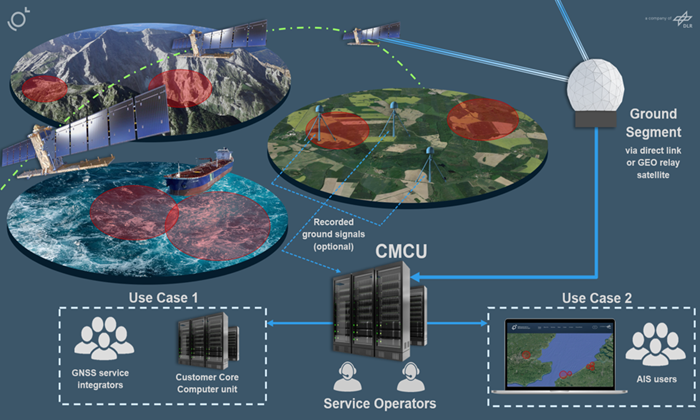
The German company DLR GfR mbH has officially launched RESIST 2, a European Space Agency (ESA) project aimed at improving the resilience and security of satellite navigation services. The project will develop advanced methods and technologies to detect, assess, and mitigate manipulation, interference, and cyberattacks targeting Global Navigation Satellite Systems.
Satellite navigation has become an essential pillar of modern society, supporting sectors such as aviation, transport, logistics, telecommunications, and energy networks. However, its growing importance also implies an increased risk of intentional interference and signal spoofing.
The Port of Marín is the only European port participating in the development of this project, which will improve maritime security and navigational safety by installing a Ground Reference Station (GRS) of the RESIST system at its facilities. This initiative reflects the Port's firm commitment to adopting cutting-edge European technologies that strengthen the resilience of navigation systems against interference, guaranteeing the highest operational safety standards for ships and port infrastructure.
With its collaboration in RESIST, the Port of Marín is advancing innovation in the maritime sector, contributing to a crucial European effort to protect critical infrastructure through robust satellite navigation solutions. This proactive approach demonstrates its commitment to integrating advanced technology into daily operations, boosting both competitiveness and environmental responsibility through safer and more efficient maritime traffic management.
RESIST is an example of successful collaboration between European institutions, industry, and public entities to improve transport security and the digital resilience of critical infrastructure.
Building on the achievements of its predecessor, RESIST 1.0, this new project expands the technical scope with new operational approaches, including raw signal analysis for the early detection of tampering and interference (such as spoofing or jamming), real-time assessment of signal quality and integrity, and fusion of data from multiple sources to improve the robustness and reliability of navigation solutions.
Thanks to these advancements, future users of satellite navigation systems will not only be able to determine if a signal has been compromised, but also assess the severity of the incident and define appropriate countermeasures.
RESIST 2 is led by DLR GfR mbH, in cooperation with leading European research and industry partners, under contract with the European Space Agency (ESA). Together, they are working to ensure that Europe’s satellite navigation infrastructure remains secure and reliable in the face of emerging threats. As part of this deployment, the Galician technology company Triple Alpha, specializing in advanced engineering solutions, will collaborate as a supplier for DLR GfR mbH, validating the system's application programming interface (API) within the RESIST framework.
It is at this point that the Port of Marín was selected, taking into account its commitment to innovation and its contribution to the development of high-value industrial capabilities in Galicia.
In the coming months, the consortium will deploy RESIST (Ground Reference Stations) at the Port of Marín and at the DLR Cochstedt Airport (Germany) to carry out a comprehensive validation of RESIST under real-world operating conditions.
In the long term, the goal is for RESIST to contribute to making GNSS-based services more resilient, secure, and reliable, guaranteeing their availability for critical infrastructure and users worldwide.